RBI Rate Hike Puts Housing Affordability In Focus As Mid-Income Buyers Face Pressure
Date Posted : 2026-10-07
Original Article Link : https://www.businessworld.in/article/rbi-rate-hike-puts-housing-affordability-in-focus-as-mid-income-buyers-face-pressure-627269
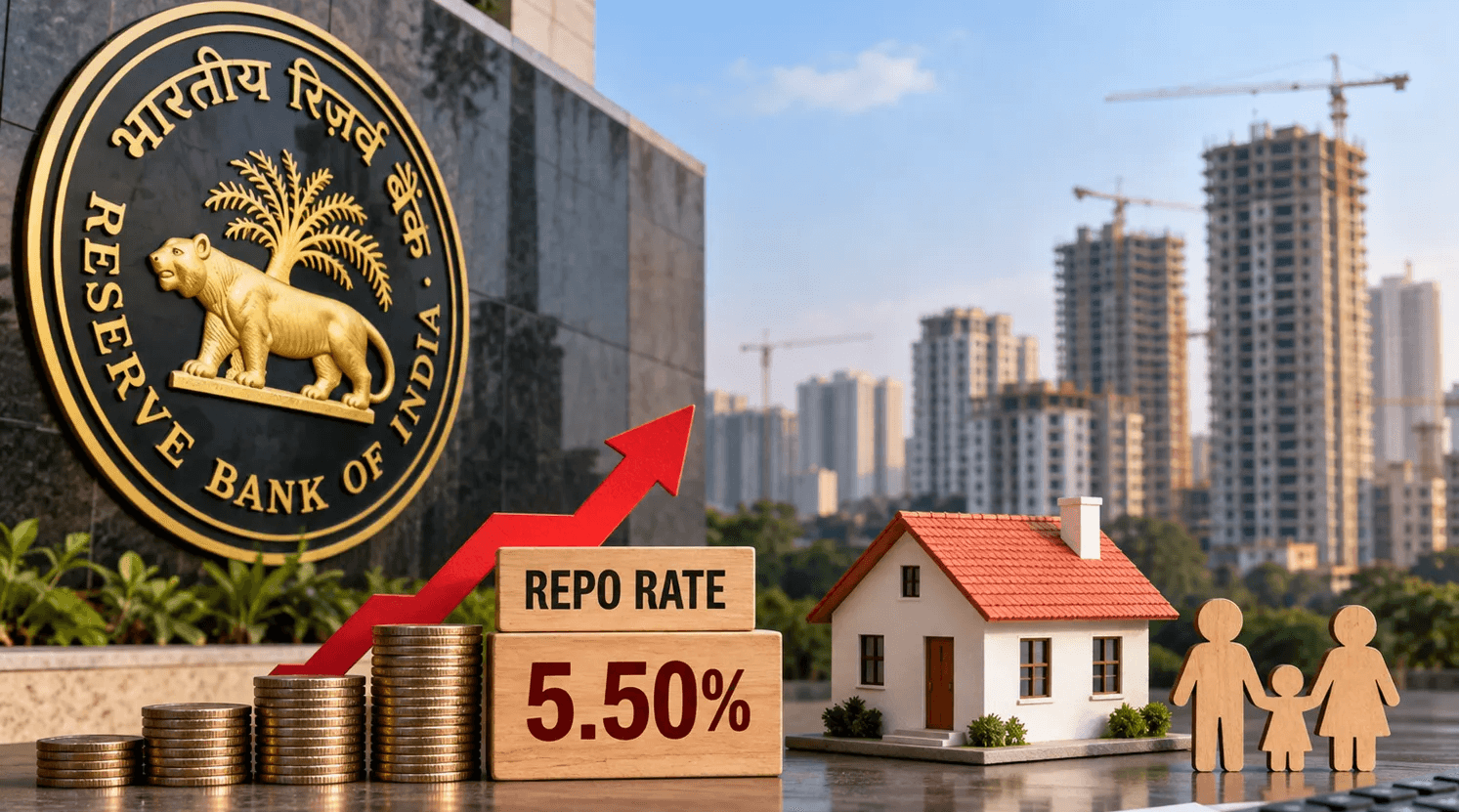
The Reserve Bank of India’s (RBI) decision to raise the repo rate by 25 basis points to 5.50 per cent could put pressure on housing affordability, particularly for first-time and mid-income buyers, even as premium housing demand remains relatively resilient. The increase comes ahead of the festive season, when developers typically look to convert buyer interest into sales.
The impact will depend on how quickly lenders adjust home-loan rates, whether prospective buyers reconsider their budgets and how developers respond to higher financing costs. The rate increase does not automatically translate into an immediate rise in every borrower’s equated monthly instalment (EMI), as the outcome depends on the lender, loan terms and rate-reset mechanism.
Industry experts says that that for buyers with floating-rate loans, a higher lending rate can increase the EMI or extend the repayment tenure, depending on the lender’s approach. Even a marginal change can influence purchasing decisions among households that rely heavily on home loans and have limited room to absorb higher monthly payments.
Harsh Jagwani, Managing Director, Notandas Realty, said, “The increase in repo rates by the RBI by 25 basis points will have an impact on the real estate sector in the coming months. As the festive season is coming up and residential sales were expected to jump during this period, this rate hike will have an impact on housing sale sentiment for first-time and mid-income buyers. A marginal increase in home-loan rates plays an influential role in purchase decisions, and its impact in the upcoming months will be noticed. At the same time, the rate hikes won’t have any significant impact on the luxury real estate segment.”
Affordability Remains Key
The concern is whether higher borrowing costs prompt some buyers to delay their decisions during a period when developers are seeking stronger festive-season sales. Lalit Parihar, Managing Director, Aaiji Group, said, “Affordability is already a concern among buyers and by increasing borrowing costs may hurt certain section of homebuyers.”
The effect may not be uniform across price categories or cities. Buyers who are already close to their borrowing limits could reassess the size or location of the home they intend to purchase. Srishti S Anandd, Cofounder and Chief Advisor, Paradigm Realty, said, “Interest-rate sensitivity is naturally higher among first-time and affordability-driven buyers, while premium and luxury housing tends to be supported by a different buyer profile and a greater emphasis on the quality, location and long-term value of the asset.”
The key distinction is between a change in buyer sentiment and a measurable decline in transactions. A rate increase can make prospective buyers more cautious without immediately leading to cancellations or a broad contraction in demand. The actual outcome will depend on income growth, property prices, the availability of suitable homes and the cost of financing.
Anshuman Magazine, Chairman and Chief Executive Officer for India, South-East Asia, Middle East and Africa at CBRE said, “We expect the impact on housing demand to stay measured, particularly in the mid and premium segments, where the underlying demand is still healthy. A 25 basis point increase in the repo rate will push borrowing costs up a little, but we expect the sector to hold up,”.
Developers Face Higher Costs
The implications extend beyond homebuyers. Developers rely on financing for land acquisition, construction and working capital, while institutional investors assess projects against borrowing costs, expected returns and execution risks. Higher financing costs can influence project viability and investment timelines, particularly for projects with longer development cycles.
Ankur Jalan, Chief Executive Officer, Golden Growth Fund, a category II real estate-focused alternative investment fund, said, “For AIFs, which typically deploy patient institutional capital into development, redevelopment and asset-backed opportunities, a higher interest-rate environment can influence project financing costs, acquisition valuations and investment timelines.”
The change could also make investors more selective about the projects they finance. Developments with clear demand, credible execution schedules and stronger cash flows may be better placed to attract capital than projects whose returns depend on optimistic sales assumptions or a quick turnaround.
For developers, the practical challenge will be to manage borrowing costs without making homes less affordable through higher prices. Whether companies absorb some of the additional cost, adjust project launches or revise pricing will depend on their balance sheets, existing debt and the strength of demand in their target markets.
The commercial property segment faces a related but different set of considerations. Higher financing costs can affect developers’ investment decisions and businesses’ expansion plans, although demand for office space also depends on hiring, business growth and the need for suitable workplaces.
Mukesh Choudhary, Managing Director, Accuspace, said, “A repo rate hike and signal of future hikes could have some impact on the office real estate segment, primarily through higher financing costs and its potential influence on corporate expansion and capital expenditure decisions.”
However, Choudhary said demand for quality office space continued to receive support from business expansion, growth in global capability centres and the need for modern, well-located workplaces. The rate increase, therefore, may affect the cost of developing and occupying commercial property without necessarily reversing demand where companies continue to expand.
Festive Season Becomes Test
The next few months will provide a clearer indication of whether the rate increase materially changes housing demand. Developers will be watching bookings and buyer enquiries, while lenders’ decisions on passing on the higher policy rate will determine the immediate financing impact. Mayur R Shah, Vice Chairman, Marathon Nextgen Realty and former President of CREDAI-MCHI, said, “Homebuyers are taking a more holistic view of affordability, considering connectivity, product quality and long-term value alongside borrowing costs.”
This suggests that the interest rate is one factor in a larger purchase decision. Connectivity, access to employment centres, infrastructure and the suitability of a property for long-term use will continue to influence buyers. However, these considerations may not offset higher borrowing costs for households whose budgets are already stretched.
For now, the 25-basis-point increase is a potential constraint rather than proof of a housing-market slowdown. The immediate impact is likely to be more visible among financing-dependent buyers, while premium housing and quality commercial assets may draw support from their respective demand drivers.
The festive season will test whether those fundamentals are strong enough to sustain transactions as borrowing costs rise. The more decisive indicators will be actual sales, the pace at which banks adjust lending rates and whether developers can maintain demand without compromising affordability.