Top Redevelopment Builders in Mumbai: 10 Things Every Housing Society Must Check Before Choosing a Developer

Table of Contents
- Why Choosing the Right Redevelopment Builder Matters
- What Makes the Top Redevelopment Builders in Mumbai Stand Out?
- 10 Things to Check Before Selecting a Redevelopment Builder
- Understanding Redevelopment Offers: What Should Your Society Compare?
- Legal Checks Every Housing Society Should Complete
- Common Mistakes to Avoid During Redevelopment
- How to Make the Final Decision
- Frequently Asked Questions
Why Choosing the Right Redevelopment Builder Matters
Across Mumbai, redevelopment is becoming an important consideration for housing societies dealing with ageing buildings, rising maintenance costs and changing residential needs. A building that once served its residents well may now require repeated waterproofing, plumbing repairs, lift upgrades and structural maintenance. For many societies, redevelopment offers an opportunity to improve living conditions while making better use of the property's development potential.
However, the success of a redevelopment project depends on more than the new building's design or the additional carpet area promised to existing members. The developer must manage legal documentation, statutory approvals, construction funding, temporary accommodation and the expectations of an entire residential community.
Consider a familiar situation. Two developers approach the same housing society with attractive proposals. One promises more additional area and a larger corpus, while the other offers slightly lower benefits but provides a detailed feasibility report, verified financial credentials and references from previously redeveloped societies. The second proposal may prove more dependable, provided its terms and execution capabilities withstand independent scrutiny.
This is why selecting among the top redevelopment builders in Mumbai requires a structured evaluation. The objective is not simply to identify the developer making the biggest offer. It is to find a partner capable of fulfilling contractual commitments without putting the society's property, finances or members' interests at unnecessary risk.
What Makes the Top Redevelopment Builders in Mumbai Stand Out?
Redevelopment involves challenges that are different from those of constructing a residential project on vacant land. The developer must account for existing residents, established ownership rights, rehabilitation obligations and the commercial feasibility of the proposed project.
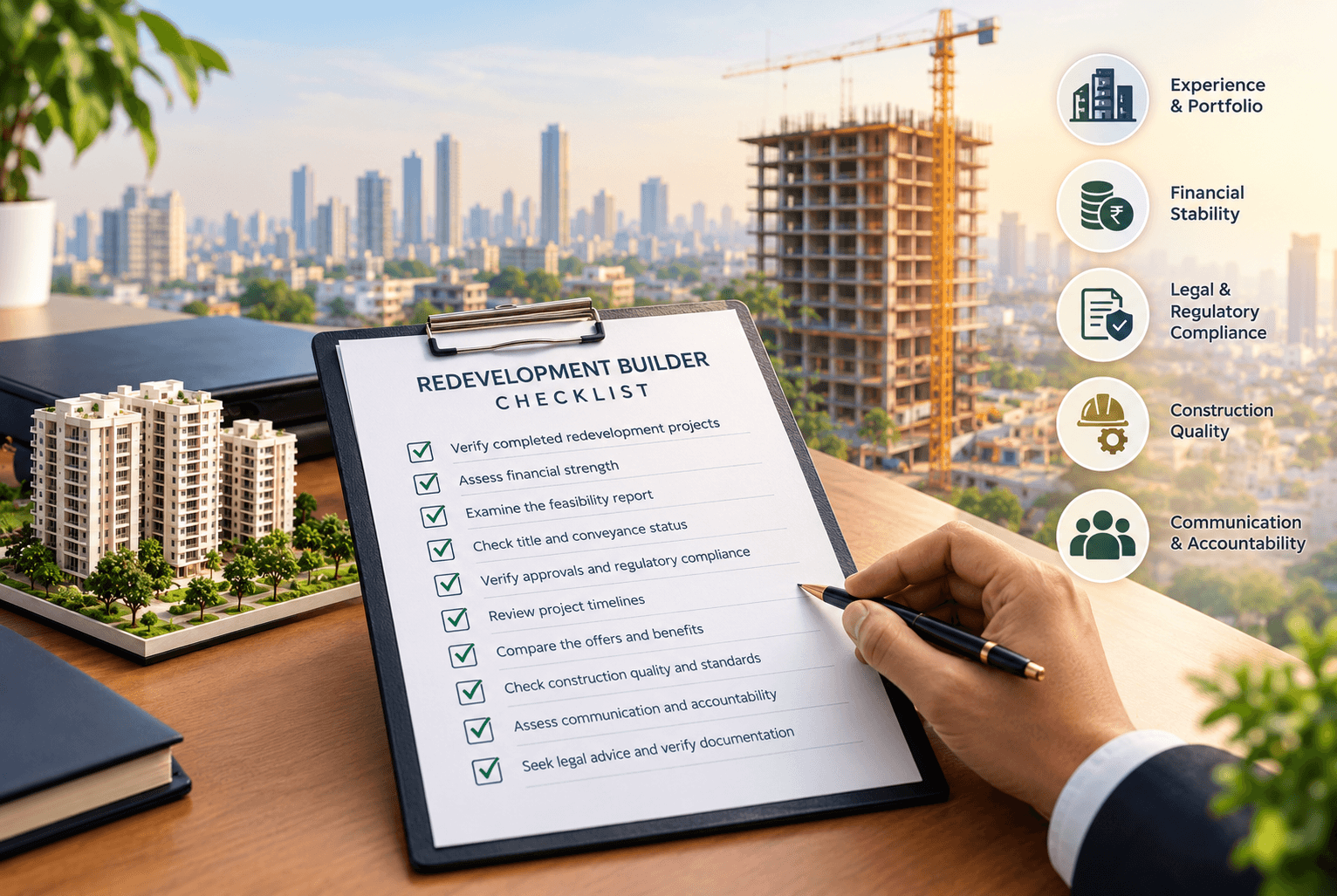
Experienced redevelopment builders should demonstrate strength in five key areas:
- Redevelopment experience: A verifiable record of completed society redevelopment projects, not just conventional residential construction.
- Financial capacity: Sufficient funding arrangements to support construction, relocation commitments and other contractual obligations.
- Legal and regulatory understanding: Familiarity with property titles, conveyance, municipal permissions, applicable development regulations and Maharashtra RERA requirements.
- Construction and project management: Realistic schedules, quality-control procedures and transparent progress reporting.
- Communication and accountability: A clear process for addressing residents' concerns, handling changes and resolving disputes.
A developer's reputation is valuable, but reputation alone is not proof of performance. The managing committee should verify claims through completed projects, documented records and direct conversations with existing or former society members.
10 Things to Check Before Selecting a Redevelopment Builder
Before shortlisting the best redevelopment builders in Mumbai, your society should establish a consistent evaluation process. Applying the same checks to every proposal makes comparisons more objective and reduces the influence of sales presentations.
1. Verify completed redevelopment projects
Ask for details of projects where existing housing societies have been redeveloped. Visit completed buildings where possible and speak directly with residents about construction quality, possession timelines and the developer's responsiveness.
A developer with an impressive portfolio of new residential towers may still have limited experience managing the specific challenges of society redevelopment.
2. Assess financial strength
Redevelopment projects require substantial funding before the developer can realise revenue from new saleable apartments. Ask about the proposed funding structure, lender relationships, outstanding financial obligations and the progress of other ongoing projects.
A large number of unfinished projects, unexplained construction stoppages or repeated payment disputes deserve closer examination.
3. Examine the feasibility report
The developer should explain the property's development potential, existing member entitlements, rehabilitation requirements, anticipated construction costs and proposed saleable component.
Compare the assumptions behind competing proposals. An unusually generous offer may depend on development potential or commercial assumptions that require independent verification.
4. Check title and conveyance status
Review the property's ownership documents, conveyance records, land records and any existing encumbrances. Older societies may discover that conveyance was never completed or that historical documentation contains inconsistencies.
These issues should be identified early, with independent legal advice on how they can be resolved.
5. Verify approvals and regulatory compliance
Ask the developer to outline the applicable approval process, including relevant municipal permissions and project registration requirements. Verify RERA registration where applicable through the official Maharashtra RERA portal.
The exact approvals depend on the property's location, ownership structure and redevelopment model. Avoid accepting verbal assurances as a substitute for documentary evidence.
6. Compare contractual member benefits
Additional carpet area, corpus payments, temporary rent, shifting expenses and other benefits should be clearly documented. Confirm the calculation method, payment dates and conditions attached to each commitment.
7. Review timelines and delay protections
The redevelopment agreement should specify key milestones, possession obligations and the consequences of delays. Temporary accommodation arrangements deserve particular attention because members may need to manage rent and existing financial commitments simultaneously.
8. Evaluate construction quality
Inspect completed projects for finishing, waterproofing, common-area maintenance, lift performance and overall workmanship. Ask what quality-assurance procedures and construction standards the developer follows.
9. Assess communication practices
Find out how residents will receive progress updates and how complaints will be escalated. Regular written reporting and designated points of contact can help prevent misunderstandings during a lengthy project.
10. Obtain independent professional advice
Appointing independent legal and technical professionals gives the society a separate assessment of the developer's proposal. Depending on the project's complexity, financial or project-management advice may also be useful.
Understanding Redevelopment Offers: What Should Your Society Compare?
The highest offer is not automatically the best offer. Society members should evaluate the complete commercial proposal alongside the developer's ability to deliver it.
Evaluation factor | What the society should verify |
| Additional carpet area | Exact area offered and the contractual measurement basis |
| Corpus amount | Payment value, timing and conditions |
| Temporary rent | Monthly amount, escalation provisions and payment schedule |
| Shifting expenses | Number of payments and applicable conditions |
| Project timeline | Milestones, expected possession and delay provisions |
| Financial capacity | Funding arrangements and ability to meet obligations |
| Legal clarity | Title status, agreement terms and applicable approvals |
| Construction quality | Specifications, materials and quality-control process |
For example, one proposal might promise a higher corpus but leave rent escalation unclear. Another might offer a more moderate corpus with clearly defined payments, stronger delay protections and a realistic execution plan. Members should compare the actual contractual value and risk of both offers rather than focusing on a single headline figure.
The society should also understand how the developer has calculated the project's feasibility. Plot configuration, permissible FSI, applicable development regulations, rehabilitation requirements and construction economics all influence what can realistically be delivered.
Legal Checks Every Housing Society Should Complete
Legal due diligence is essential because redevelopment agreements can affect members' homes and financial interests for several years.
Before signing, the society should arrange an independent review of:
- Property title, conveyance and relevant land records.
- Existing mortgages, encumbrances and material litigation.
- Society registration documents and member records.
- The redevelopment agreement and individual member documentation.
- Carpet area calculations, corpus and temporary accommodation commitments.
- Construction timelines, termination provisions and remedies for contractual breaches.
- Applicable statutory approvals and Maharashtra RERA obligations.
Where conveyance is incomplete, the society should obtain advice on the appropriate process, which may include deemed conveyance where legally applicable.
Members should also understand the approvals required before demolition, construction and eventual occupation. Requirements vary by project, so the developer's proposed approval schedule should be reviewed by qualified professionals familiar with Mumbai redevelopment.
Most importantly, the society should not rely solely on the developer's legal team to protect its interests. Independent representation helps ensure that the agreement reflects the society's requirements rather than only the developer's commercial objectives.
Common Mistakes to Avoid During Redevelopment
Even a well-intentioned society can encounter difficulties if decisions are made without adequate verification.
Choosing the highest bidder without checking feasibility: Generous promises can become difficult to fulfil when the underlying financial or regulatory assumptions are unrealistic.
Relying on verbal commitments: Every important benefit, payment obligation, deadline and protection should be included in the appropriate written agreement.
Ignoring the developer's ongoing projects: Review whether existing projects are progressing and whether the developer has the capacity to undertake another substantial commitment.
Skipping independent legal scrutiny: A signed agreement can create long-term obligations. Members should understand the implications before authorising it.
Allowing communication gaps: Regular general body discussions, documented decisions and clear communication channels help keep members informed and reduce avoidable disputes.
Assuming redevelopment guarantees a fixed return: Additional area, corpus and other benefits depend on the negotiated agreement and the project's feasibility. They should not be treated as guaranteed until properly documented.
How to Make the Final Decision
A practical way to choose among shortlisted redevelopment builders is to create an evaluation scorecard before reviewing their proposals.
The society can assign weights to the factors that matter most, such as redevelopment experience, financial capacity, legal compliance, commercial benefits and construction quality. Each developer should be assessed against the same criteria, supported by evidence rather than presentation quality.
A useful final checklist includes:
- Completed redevelopment projects that can be independently verified.
- A documented feasibility assessment.
- Clear funding arrangements and evidence of financial capacity.
- A credible legal and regulatory roadmap.
- Transparent member benefits and temporary accommodation provisions.
- Defined construction milestones and delay protections.
- Independent legal and technical review.
- A documented process for progress reporting and dispute resolution.
The managing committee should share relevant findings with members and follow the applicable legal and society decision-making procedures before proceeding.
Ultimately, the right redevelopment partner is one that can explain its proposal clearly, substantiate its promises and accept reasonable scrutiny. Redevelopment is a long-term commitment, and a careful selection process gives the society a stronger foundation for protecting members' interests while planning a better residential future.
Latest Blogs
Blog
Paradigm Realty
2026-10-18
Real Estate in Bandra: Property Prices, Connectivity, Lifestyle and Investm...
Table of ContentsWhy Bandra Remains One of Mumbai’s Most Desirable Residential LocationsProperty Prices in Bandra in 20264BHK Flat in Bandra: What Sho...

Blog
Paradigm Realty
2026-10-18
Living in Shimpoli, Borivali West: A Practical Guide to Flats, Connectivity...
Table of ContentsWhy Consider Living in Shimpoli, Borivali West?Everyday Conveniences That Make Life EasierConnectivity and Daily Commutes from Shimpo...

Blog
Paradigm Realty
2026-10-18
Sea Facing Apartments in Bandra: 7 Reasons to Invest in Ocean View Luxury H...
Table of ContentsWhy Sea Facing Apartments in Bandra Remain in Demand7 Benefits of Living in Ocean View Flats in BandraWhat Makes Bandra West a Premiu...
Blog
Paradigm Realty
2026-10-18
Top Redevelopment Builders in Mumbai: 10 Things Every Housing Society Must ...
Table of ContentsWhy Choosing the Right Redevelopment Builder MattersWhat Makes the Top Redevelopment Builders in Mumbai Stand Out?10 Things to Check ...
Blog
Paradigm Realty
2026-10-18
Beyond Extra Carpet Area: How to Choose the Right Redevelopment Builder in ...
Table of ContentsWhy Mumbai Housing Societies Need the Right Redevelopment PartnerHow to Evaluate the Top Redevelopment Builders in MumbaiUnderstandin...
Blog
Paradigm Realty
2026-10-18
How Infrastructure Development Is Shaping Real Estate Growth in Bandra: Is ...
Table of ContentsIntroduction: Why Infrastructure Matters in BandraHow Major Infrastructure Projects Are Transforming BandraHow Connectivity Influence...