The Redevelopment Process, Step by Step: From Society Resolution to Possession

Ask any managing committee member who has been through a redevelopment project, and they'll tell you the same thing: nobody warned them how many milestones stood between the first meeting and the day they got their keys back. Society redevelopment in Mumbai isn't a single transaction. It's eight distinct stages, each with its own paperwork, its own regulator, and its own way of quietly adding a year to the timeline if nobody's watching it closely.
The good news is that the process is well defined. It isn't a black box. Every stage has a legal basis, a typical duration, and a known failure mode. If you're a committee member trying to figure out whether your project is on track, or a flat owner trying to understand what happens after you vacate, this is the walkthrough you need: what happens at each step, why it exists, and where projects actually get stuck.
Step 1: The Structural Audit Nobody Can Skip
Before anyone talks about developers or corpus funds, the building needs a structural audit. For any structure over 30 years old, this is mandatory under Section 353-B of the Mumbai Municipal Corporation Act, and it ends with the building being classified as C1, C2, or C3 based on how urgently it needs intervention.
Alongside the audit, a feasibility study looks at the numbers: how much carpet area exists today, how much FSI and TDR the plot is entitled to under DCPR 2034, and what the rough project economics look like. This is the stage where a managing committee moves from “should we redevelop” to “here's what redevelopment could actually look like for us,” backed by data rather than assumptions.
Step 2: The Special General Body Meeting
This is where redevelopment becomes official. A Special General Body Meeting, or SGBM, is called with a notice period of typically two months to every member of the society. Most society bye-laws, along with government norms, require a quorum of roughly two-thirds of all members, and the redevelopment resolution needs approval from at least 75% of those present and voting.
Here's the detail that surprises most first-time committee members: the minutes of this meeting, once signed, get filed with the Registrar of Co-operative Societies. That filing, not the developer agreement and not the construction start date, is what regulators treat as the formal beginning of the project.
Step 3: Finding the Right Developer
Once the resolution is in place, the search for top builders in Mumbai begins. Good practice, and in several cases an explicit state government requirement, calls for inviting a minimum of three tenders from reputed real estate developers in Mumbai. These proposals are evaluated side by side on a comparative statement covering the corpus fund offered, transit rent during construction, additional carpet area for existing members, and the proposed construction timeline.
Step 4: Making It Legal — The Redevelopment Agreement
This is the step where things get formally binding. The commercial and legal terms between the society and the developer go into a Redevelopment Agreement, and if the developer needs a Power of Attorney for specific regulatory filings, that gets executed alongside it. Both documents must be registered under the Registration Act, and stamp duty applies under the Bombay Stamp Act.
The Supreme Court settled a question here that used to cause real confusion: in Suraj Lamp Industries (2011), the Court held that an unregistered agreement paired with a Power of Attorney cannot stand in for a registered conveyance. This isn't a technicality that can be sorted out later. Registration at this stage is what gives the agreement legal teeth, and any developer or consultant suggesting it can wait is steering the society toward risk.
Step 5: The Approvals That Unlock Construction
With the agreement registered, the developer moves to secure the approvals needed to actually build. First comes an Intimation of Disapproval, commonly called an IOD, followed by a Commencement Certificate from the relevant planning authority, which in Mumbai is either the Municipal Corporation of Greater Mumbai or the applicable Urban Local Body depending on where the plot sits.
If the project crosses eight units or 500 square metres in built-up area, which most society redevelopments do, MahaRERA project registration becomes mandatory at this point. This is a meaningful moment for existing members, not just a compliance checkbox. Once the project is RERA-registered, every existing member is formally recognised as a RERA allottee, which brings escrow protections, mandatory disclosures, and carpet-area guarantees into the picture, the same protections any buyer purchasing a new flat would get.
This is also the stage where projects most often lose time. Getting the Commencement Certificate from the municipal authority is, by a wide margin, one of the two biggest sources of delay in the entire process, the other being litigation from a dissenting minority of members, which we'll come back to.
Step 6: Vacating, Transit Rent, and the Build Itself
Members hand over their existing premises in exchange for transit rent, or in some structures, an alternate accommodation arranged by the developer. Construction then proceeds against a milestone schedule that should have been agreed at the tender stage.
If the developer is selling additional units built using surplus FSI during this period, and most redevelopment projects involve exactly this, RERA's escrow rules under Section 4(2)(l)(D) kick in the same way they would for any other RERA project. Seventy percent of collections from those sales have to sit in a designated escrow account, released only against certified construction milestones. This is one of the more underappreciated protections in the entire framework. It ties the developer's cash flow directly to actual progress on site, rather than letting sold inventory fund unrelated activity.
Step 7: Occupation Certificate Before Anyone Moves Back In
A building can look finished and still not be legally ready for possession. The Occupation Certificate, or OC, is the document that makes possession valid, regardless of how complete the physical construction appears.
The Supreme Court was direct about this in Kolkata West International (2019): possession handed over without an OC does not count as legally valid possession. For members, this is the difference between moving into a home with clean legal standing and moving into one that could create complications later, around registration, resale, or even basic occupancy rights. It's worth asking your developer directly, at handover, whether the OC is in hand, not just whether the flat is ready to be shown.
Step 8: Conveyance and the Long Tail After Handover
The final step is conveyance, or deemed conveyance where the original title was never fully regularised, transferring the redeveloped property to the society along with responsibility for maintaining the building. But the developer's obligations don't end the day the keys are handed over. RERA Section 14(3) puts a five-year structural defect liability period on the developer, during which they remain on the hook for rectifying qualifying structural issues. That's a meaningful safety net for a society taking over a newly built structure, and it's worth having in writing, not just in memory, when handover happens.
What a Realistic Timeline Actually Looks Like
Across the Mumbai Metropolitan Region, the journey from SGBM to possession typically runs three to five years under normal conditions. When projects run longer than that, the cause is almost always one of two things: delays in securing the Commencement Certificate from the municipal authority, or litigation from a dissenting minority of members that stalls the project mid-stream. Both of these deserve a closer look on their own, which is exactly what we cover in our companion piece on redevelopment risks and how societies can protect themselves against them.
Why the Sequencing Matters More Than Any Single Step
Here's the pattern worth noticing across all eight steps: none of them is optional, and none of them can be meaningfully rushed without creating risk somewhere downstream. A society that skips proper ratification at the tender stage often ends up dealing with member disputes at the agreement stage. A developer who delays RERA registration until construction is already underway puts existing members' allottee protections at risk. The projects that finish closest to the three-year mark are, almost without exception, the ones where every milestone was tracked against a fixed schedule from day one, not managed informally as things came up.
This is precisely where a redevelopment specialist earns its place over a general contractor. Paradigm Realty currently has two ongoing redevelopment projects, and the delivery process for both tracks each of these eight milestones explicitly: structural and feasibility sign-off, the sequencing from SGBM through to a registered agreement, RERA registration completed ahead of construction commencement, and possession tied directly to OC readiness. That schedule is shared with the society at the outset, as a documented plan rather than a set of steps figured out along the way.
If your society is somewhere in this process, whether you're still weighing the SGBM or already knee-deep in construction milestones, knowing exactly which of these eight steps you're on, and what should have happened before it, is the single best tool you have for keeping the project honest and on schedule.
Latest Blogs
Blog
Paradigm Realty
2026-10-18
Real Estate in Bandra: Property Prices, Connectivity, Lifestyle and Investm...
Table of ContentsWhy Bandra Remains One of Mumbai’s Most Desirable Residential LocationsProperty Prices in Bandra in 20264BHK Flat in Bandra: What Sho...

Blog
Paradigm Realty
2026-10-18
Living in Shimpoli, Borivali West: A Practical Guide to Flats, Connectivity...
Table of ContentsWhy Consider Living in Shimpoli, Borivali West?Everyday Conveniences That Make Life EasierConnectivity and Daily Commutes from Shimpo...
Blog
Paradigm Realty
2026-10-18
Sea Facing Apartments in Bandra: 7 Reasons to Invest in Ocean View Luxury H...
Table of ContentsWhy Sea Facing Apartments in Bandra Remain in Demand7 Benefits of Living in Ocean View Flats in BandraWhat Makes Bandra West a Premiu...
Blog
Paradigm Realty
2026-10-18
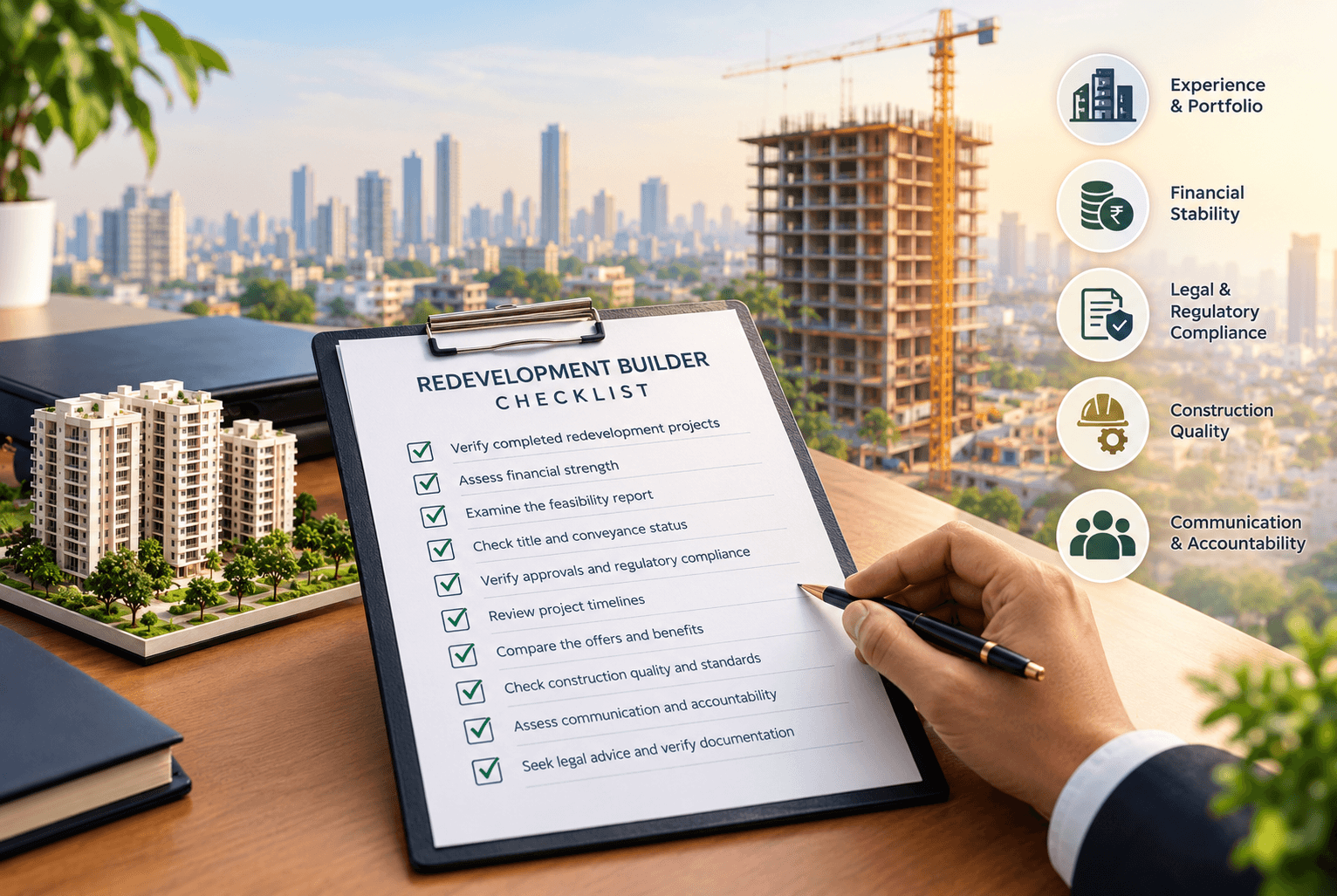
Top Redevelopment Builders in Mumbai: 10 Things Every Housing Society Must ...
Table of ContentsWhy Choosing the Right Redevelopment Builder MattersWhat Makes the Top Redevelopment Builders in Mumbai Stand Out?10 Things to Check ...

Blog
Paradigm Realty
2026-10-18
Beyond Extra Carpet Area: How to Choose the Right Redevelopment Builder in ...
Table of ContentsWhy Mumbai Housing Societies Need the Right Redevelopment PartnerHow to Evaluate the Top Redevelopment Builders in MumbaiUnderstandin...
Blog
Paradigm Realty
2026-10-18
How Infrastructure Development Is Shaping Real Estate Growth in Bandra: Is ...
Table of ContentsIntroduction: Why Infrastructure Matters in BandraHow Major Infrastructure Projects Are Transforming BandraHow Connectivity Influence...